
Mosaic
One foundation under every Starworks product.
- C++23
- Zero dependencies
- Header-mostly
- MIT
Every product starts here.
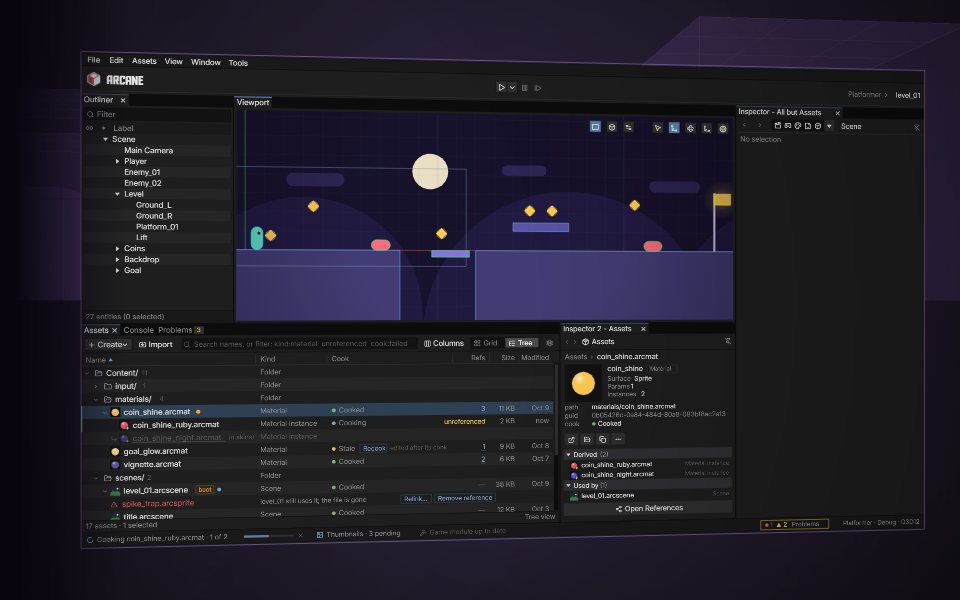
The zero-dependency C++ layer beneath Arcane, Astra and Manifold2D: platform detection, deterministic SIMD, and the seams every component plugs into. Mosaic owns one canonical copy of these pieces, so every component builds on the same ground.
Small. Deliberate. Shared.
Eight pieces every product needs, kept in one canonical copy.
Platform
Architecture, compiler and SIMD-capability detection: MOSAIC_HAS_AVX2, MOSAIC_HAS_NEON, MOSAIC_FORCEINLINE and friends.
Jobs
IWorkScheduler, the threading seam. Mosaic creates no threads: the host injects a scheduler, and SerialWorkScheduler is the deterministic default.
Log
A logging seam: the host installs one sink with SetLogSink, and every library reports through it.
Assert
MOSAIC_ASSERT behind an injected assert handler. A failing guard reaches the host even with logging silenced.
Simd / Wide
Lane-wide f32w, i32w and b32w for solver-style math: AVX2, NEON or scalar, chosen at compile time, and bit-identical to the scalar path.
Simd / Bits
Byte matching, 128- and 256-bit bitmaps and hashing: the toolbox behind SwissTable and bloom acceleration.
Bits · BitSet
Generic bit intrinsics and a compact bit set: one canonical copy instead of one per library.
FunctionRef
A non-owning, zero-allocation callable: how work crosses the scheduler seam without touching the heap.
Mosaic declares. The host decides.
Real code from Arcane and Manifold2D, lightly trimmed: how a host plugs into each seam.
Arcane adapts its own task system to the seam; Mosaic never makes a thread
// Arcane/Jobs/ArcaneWorkScheduler.hpp
class ArcaneWorkScheduler final : public Mosaic::IWorkScheduler
{
public:
    void ParallelFor(std::size_t count, std::size_t minBatch,
                     Mosaic::FunctionRef<void(std::size_t, std::size_t,
                                              std::uint32_t)> fn) override
    {
        if (m_exec == nullptr)
        {
            if (count != 0) fn(0, count, 0);   // serial: worker 0
            return;
        }
        m_exec->ParallelFor(count, minBatch,
            [&](std::size_t b, std::size_t e, std::uint32_t w) { fn(b, e, w); });
    }

    std::uint32_t WorkerCount() const noexcept override
    {
        return m_exec ? m_exec->WorkerCount() : 1u;
    }

private:
    Arcane::ITaskExecutor* m_exec = nullptr;
};
Arcane routes every library’s logs and asserts into its own logger
// Arcane/Base/Log.cpp
// noexcept sink: forward into the engine logger. category + message are fmt
// ARGUMENTS (literal format) so a stray {} in a message cannot fmt-inject.
void MosaicLogSinkImpl(const Mosaic::LogRecord& r, void* /*user*/) noexcept
{
    try
    {
        Arcane::Log::Engine()->log(
            spdlog::source_loc{r.location.file_name(),
                               static_cast<int>(r.location.line()),
                               r.location.function_name()},
            ToSpd(r.level), "[{}] {}", r.category, r.message);
    }
    catch (...) {}
}

// once, at start-up: Astra and Manifold2D now log and assert through Arcane
Mosaic::SetLogSink(MosaicSink(), nullptr);
Mosaic::SetAssertHandler(Arcane::Assert::MosaicHandler(), nullptr);
Manifold2D solves contacts lane-wide: eight at a time on AVX2, four on NEON
// Manifold2D/Physics/Solver/ContactConstraintSimd.hpp (the normal solve)
const b32w gap = cmp_gt(s, zero);
const f32w biasGap = s * invH;
const f32w biasPen = max(ccBias * s, vMaxNeg);
f32w bias, massScale, impScale;
if (useBias)
{
    bias      = select(gap, biasGap, biasPen);
    massScale = select(gap, one, ccMassScale);
    impScale  = select(gap, zero, ccImpScale);
}
else { /* the relax pass: bias 0, scale 1/0 (elided) */ }

// vn = dot((vA + wA x rA) - (vB + wB x rB), n).
const f32w dvx = (vAx + (-wA * rAy)) - (vBx + (-wB * rBy));
const f32w dvy = (vAy + ( wA * rAx)) - (vBy + ( wB * rBx));
const f32w vn = dvx * nx + dvy * ny;

// impulse = -nMass*massScale*(vn+bias) - impScale*nImp.
f32w impulse = -nMass * massScale * (vn + bias) - impScale * nImp;
// accumulated clamp >= 0.
const f32w newI = max(nImp + impulse, zero);
impulse = newI - nImp;
nImp = newI;
store(pt.normalImpulse, nImp);Four promises.
Zero dependencies
The C++ standard library and nothing else. No Astra, Manifold2D, Arcane or third-party include ever enters Mosaic.
Creates no threads
Parallelism goes through the injected IWorkScheduler; the host decides what runs where.
Deterministic SIMD
Simd/Wide builds with strict floating point (/fp:strict, or -ffp-contract=off with no fast-math) and bit-matches the scalar path.
One arrow
Every product depends on Mosaic; Mosaic depends on none of them. Each takes one canonical copy instead of hand-rolling its own.
What it holds up.
Build on Mosaic.
Open source under the MIT licence, and the first thing every Starworks component includes.
- C++23
- Zero dependencies
- Header-mostly
- MIT